A successful beautification project does more than add colour: it must fit the way people move, see, use, and maintain a place. By the end, you will be able to identify the right intervention, compare materials, plan approvals and safety controls, and prepare a handover specification that remains useful after installation.
Key takeaways
- Match the installation to viewing distance, audience, site function, and available space.
- Survey utilities, pedestrian movement, drainage, structures, permissions, and installation access first.
- Specify weather-resistant materials, sealed graphics, safe lighting, and replaceable components.
- Plan cleaning, repainting, electrical checks, and brand updates before handover.
What Creative Beautification Includes—and What It Must Achieve
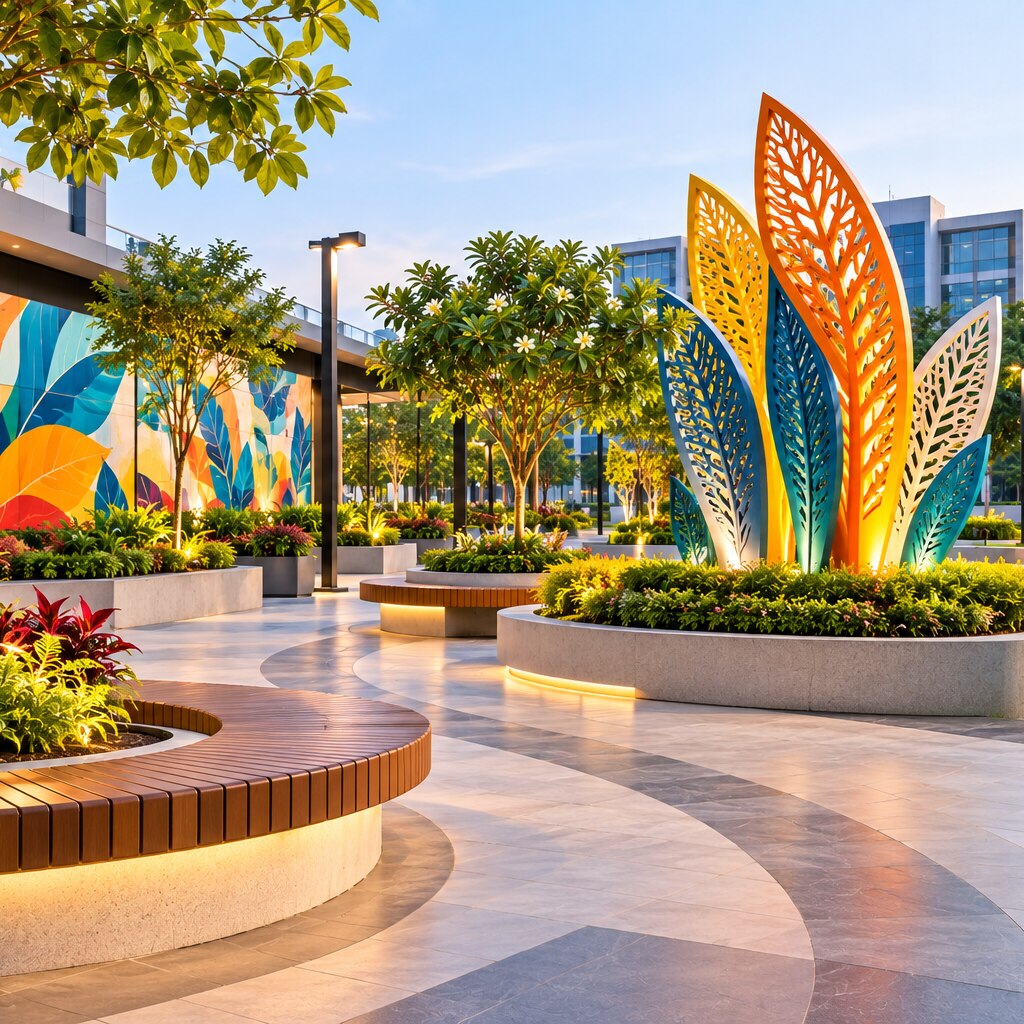
Creative beautification is a coordinated visual and functional improvement, not decoration added in isolation. It can combine murals, themed installations, planters, façades, lighting, sculptural elements, gateways, seating, branded environmental graphics, and streetscape upgrades across public spaces, commercial areas, and institutions.
Directional signage answers “where do I go?” Advertising displays answer “what should I buy?” Public art creates cultural or visual interest, while maintenance repairs or preserves existing assets.
Read the site before choosing the feature:
- Map pedestrian flow, including queues, crossings, and accessible routes.
- Measure viewing distance and identify whether people approach on foot, by vehicle, or by public transport.
- Record traffic speed; drivers need brief, high-contrast information.
- Estimate dwell time; stopping visitors can engage with more detail than passing traffic.
- Check sightlines from entrances, junctions, windows, and seating.
- Photograph competing signs, advertising, utilities, and visual distractions.
- Mark obstruction risks around exits, fire equipment, drainage, and overhead clearance.
- Note sun, shade, night visibility, cleaning access, and vandalism exposure.
A successful project must improve orientation, identity, comfort, safety, dwell time, or the visitor experience. One gateway can carry branding, a directional panel can guide visitors, and adjacent public art can create interest without making their purposes unclear.
Reject any decorative feature that blocks an accessible route, hides an emergency exit, competes with essential traffic information, or creates visual clutter.
Choose the Intervention by Site, Audience, and Viewing Distance
Road medians and footpaths need low-projection, impact-resistant elements because traffic is fast, access is tight, and stopping is unsafe. Use strong contrast and large text for drivers or distant viewers, but keep messages brief.
| Site | Best-fit intervention | Design test |
|---|---|---|
| Road medians | Stone, planters, treated timber, metal cut-outs, or low lighting | No sharp projections, blocked sightlines, or maintenance access |
| Footpaths | Flush murals, slim acrylic signs, planters, and wayfinding | Preserve the continuous accessible route and cane clearance |
| Parks and plazas | Paint murals, shade, seating, planters, interactive features, and temporary event structures | Support long dwell time without trapping movement |
| Markets | Washable graphics, queue barriers, printed flex, and replaceable panels | Allow cleaning, crowd flow, queue control, and quick replacement |
| Office campuses | Gateways, façade panels, 3D letters, and coordinated wayfinding | Build one identity instead of unrelated signs |
| Schools and hospitals | Calm murals, readable acrylic signs, shaded seating, and restrained colour | Keep routes legible, accessible, quiet, and easy to disinfect |
| Retail frontage | ACP panels, acrylic signs, LED glow signs, and 3D letters | Match viewing distance, frontage scale, glare limits, and opening hours |
| Institutional entrances | Gateways, stone, metal cut-outs, façade graphics, and wayfinding | Make arrival obvious without hiding exits or access paths |
Compare paint murals with printed flex for permanence and replacement speed; ACP panels resist weather, while acrylic signs provide clean short-range information. Non-illuminated signs are clearer in daylight, cheaper to maintain, and less disruptive where glare, light spill, or power access creates problems.
Use LED glow signs only when night visibility justifies drivers, transformers, and scheduled maintenance.
Build the Project from Site Survey to Safe Installation
A project fails after fabrication when the site, permissions, structure, or maintenance plan was never documented. Use this sequence:
1. Complete a site survey with photographs, dimensions, mounting surfaces, drainage conditions, electrical points, access equipment, and nearby utilities. Record wall and roof construction, pedestrian and vehicle approaches, and obstructions.
2. Map the audience and sightlines: note viewing distance, traffic speed, dwell time, competing signs, and whether people arrive on foot, by vehicle, or by public transport.
3. Prepare concept design options that match the site’s scale, purpose, and risk. Reject any option that blocks an accessible route, emergency exit, fire-fighting access, electrical panel, or required aisle.
4. Convert the selected option into measured drawings showing elevations, sections, fixing points, clearances, cable routes, drainage paths, and removal access. Attach a material schedule.
5. Complete structural and electrical review before approval. For façades, ACP panels, cantilevered signs, and large 3D letters, a competent structural designer must check projected area, height, gust exposure, frame stiffness, anchors, corrosion protection, and the existing wall or roof, using IS 875 Part 3 for wind-load design.
6. In Nagpur, confirm current NMC permission, landowner consent, building-owner consent, placement restrictions, illumination conditions, and removal obligations before fabrication. Apply separate checks to municipal land, private premises, road reservations, and heritage-sensitive sites.
7. Obtain artwork approval, then release fabrication only against the approved drawings and colour references.
8. Plan installation, including lifting equipment, isolation points, weather limits, and protection of public movement.
9. Perform installation inspection after erection. For events, verify exits, fire access, panels, accessible routes, and aisles, and name who can stop work for unsafe wind, rain, or electrical conditions.
10. Handover an asset register, cleaning method, inspection frequency, replacement details, warranty limits, and removal responsibility.
Specify Materials, Lighting, and Graphics for Real Outdoor Conditions
Choose materials and illuminated elements for the site’s punishment, not the showroom sample.
Substrate and installation often determine exterior service life more than headline ink technology: check UV resistance, monsoon water paths, edge sealing, impact resistance, corrosion resistance, fastener corrosion, colour fading, cleaning access, and whether one damaged component can be replaced without dismantling the installation.
| Option | Exposure and performance | Repair and installation check |
|---|---|---|
| ACP or powder-coated metal | Rigid, suitable for façades; inspect heat movement and UV exposure | Replace panels individually; seal edges and use stainless or suitably coated fasteners |
| Acrylic or polycarbonate | Good for glow faces; polycarbonate offers higher impact resistance | Design removable faces, protected joints, and accessible LED modules |
| Cast vinyl | Better than calendared vinyl for compound curves | Prepare the surface, seal edges, and allow for rivets, welds, heat, drainage, and cleaning chemicals |
| LED lighting | Low energy and heat; assess driver access, waterproofing, glare, light spill, colour temperature, and night visibility | Use replaceable modules, isolation points, shielding, dimming schedules, lower-glare optics, and luminance testing |
| Halogen, incandescent, or fluorescent | More heat or energy use, with greater maintenance burden | Provide ventilation, safe access, and matching replacement parts |
Prefer controlled brightness over maximum wattage, using CIE 150 as a reference for obtrusive light. A 600×500 mm glow sign is approximately 3.23 square feet; reconcile that area with any stated 1-square-foot minimum before costing. Select size by letter height, mounting height, viewing distance, illumination uniformity, and whether illumination is needed at all.
Make the Experience Accessible, Legible, and Permission-Ready
People can use and understand the finished space only when access, information, colour, sound, and permissions are designed together. Maintain a continuous unobstructed accessible route, and keep freestanding branding, queue barriers, planters, selfie installations, and sign projections out of head, cane, and wheelchair paths.
- Check readable contrast between text, graphics, and their background.
- Set letter height for the actual viewing distance, not the designer’s screen.
- Use non-glare surfaces and provide tactile or other accessible information where required.
- Complete QR code testing from the expected distance and in the actual lighting condition. Use dark modules on a light matte background, a clear quiet zone, and a short destination URL.
- Approve outdoor colour with a contract proof, calibrated monitor, or physical colour swatch, never an unprofiled screen. Record the selected spot colour reference or approved physical sample because CMYK values shift between solvent, latex, UV, textile, and offset printing.
For a sound-led activation, apply the Noise Pollution Rules before booking equipment. Loudspeakers and public-address systems are generally restricted from 10:00 p.m. to 6:00 a.m. unless the applicable permission or exemption exists; include daytime programming, directional speakers, and a sound check in the plan.
Keep a permission register covering municipal approvals, owner consents, electrical checks, event permissions, and removal dates. Add the installation location, approving authority, expiry date, emergency contact, and evidence of consent so a compliant design does not become an unauthorised obstruction.
Turn the Installation into a Maintainable Brand Asset
A proposal is not complete until it explains how the installation will look and function after six months. Require a maintenance specification covering cleaning, inspection, access, repairs, and removal before approving the design.
| Evidence | Weak proposal | Strong proposal |
|---|---|---|
| Location and construction | Visual mock-up only | Location plan, measured drawings, material and finish schedule, fixing details |
| Electrical control | “LED lighting included” | Electrical load, driver location, isolation point, access method |
| Aftercare | Verbal maintenance promise | Cleaning method, inspection frequency, replacement process, warranty exclusions, removal responsibility, realistic access plan |
Build an asset register listing every panel, sign, planter, light, letter set, and temporary component by exact location. Record approved artwork, colour references, substrate, fastener type, supplier details, replacement dimensions, and the documents needed for matching replacement panels.
Price a maintenance allowance for dead LED modules, corroded fixings, faded graphics, damaged acrylic, blocked drainage, and unauthorised repairs. Ask for installation controls, including anchor checks, electrical testing, protection of accessible routes, and sign-off photographs.
For a local partner such as SHUBH AD'S Pvt Ltd, compare site assessment, fabrication coordination, permission awareness, signage fabrication, commercial printing, and handover documentation—not visual mock-ups alone. A single provider can coordinate design, printing, fabrication, and installation, but competent structural, electrical, and statutory professionals remain responsible for those decisions.
Complete a launch inspection, then schedule a post-monsoon inspection. Record defects, replacements, drainage problems, colour changes, and any repair that departed from the approved design.
Related products
 | Product Details: Minimum Order Quantity 1 Piece End Use Website Preferable Date / Month Anytime Service Duration 4-5 days Type of Graphics 3D Type of... View product → |
 | Product Details: Brand Techno Packaging Website Already Exists Yes Service Duration 10 Day Min We design the whole business startup package for less... View product → |
Frequently asked questions
What does creative beautification include?
It can combine murals, themed installations, planters, façades, lighting, sculptures, gateways, seating, environmental graphics, and streetscape upgrades.
How do you choose a beautification intervention for a site?
Assess the site’s function, audience, viewing distance, pedestrian flow, available space, and the experience you want visitors to have.
What should a site survey cover before installation?
Check dimensions, utilities, drainage, structural conditions, access routes, pedestrian movement, lighting, installation methods, and required permissions.
How do you make an outdoor installation durable and maintainable?
Use materials suited to sun, rain, dust, and physical contact, then document cleaning, repainting, electrical checks, repairs, and component replacement.
Related products
 | Product Details: Minimum Order Quantity 1 Square Feet Body Material Acrylic Color Multicolor Dimension 600x500 mm Lighting Type LED We introduce... View product → |
 | Product Details: Minimum Order Quantity 1 Piece End Use Calender, Brochure, Website Type of Graphics 2D, 3D, Motion Type of Output Computer... View product → |
 | Advertising Banner - Flex Printing Services Product Details: Minimum Order Quantity 1 Pack End Use Calender, Brochure, Website Type of Graphics 2D, 3D, Motion Type of Output Computer Generated,... View product → |
 | Advertisement Designing Services Product Details: End Use Website Type of Graphics 3D Type of Output Computer Generated Usage Advertisement Brand Techno Packaging Material Paper We... View product → |