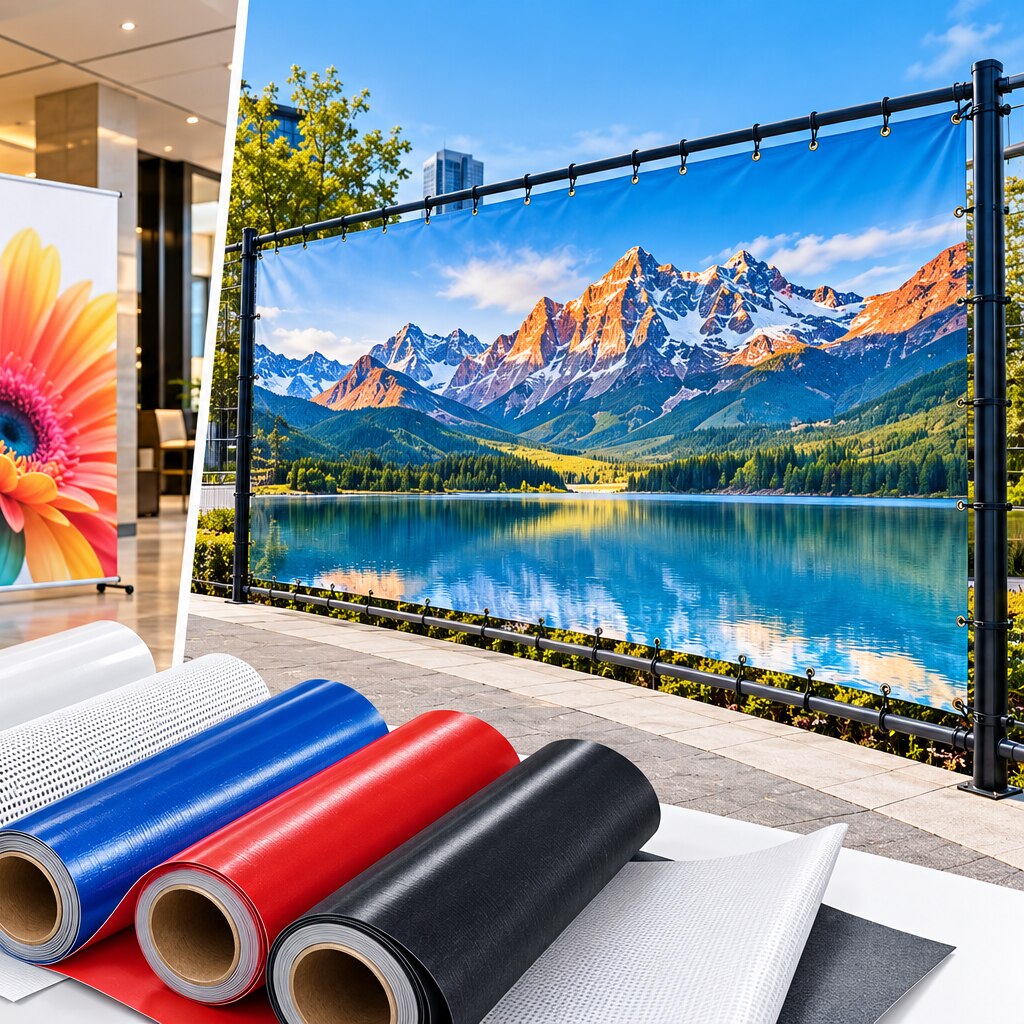
A banner that looks sharp in a showroom can glare, wrinkle, fade or fail under monsoon wind when used elsewhere. By matching the material, print construction, finishing and mounting method to the site, you can choose a banner that remains readable, safe and practical for its intended campaign period.
Key takeaways
- Measure exposure, installation time and viewing distance before choosing material.
- Use frontlit vinyl for standard displays and blockout vinyl for opaque coverage.
- Choose backlit film or fabric when light must pass through the graphic.
- Specify file resolution, hems, eyelets and seam placement before printing.
Start with the location, exposure and viewing distance
Measure the installation before comparing materials: record where the banner will hang, how long it must remain, what will strike it, and how far viewers will stand. An indoor banner at a reception desk faces different demands from an elevated hoarding or suspended storefront display.
1. Identify the setting and mounting surface. Note whether the banner will attach to a wall, fence, frame, pole, event stand or storefront, and whether people will handle, clean or fold it repeatedly.
2. Map the exposure. For an outdoor banner in Nagpur, assess direct sunlight and UV exposure, summer heat, dust, humidity, monsoon rain and wind. “Outdoor” does not guarantee continuous service; ink, finishing, mounting and cleaning determine how long the display remains usable.
3. Treat size and elevation as a wind-loading problem. Wind pressure rises approximately with the square of wind speed, so a wider banner, fewer airflow gaps or a solid mounting surface can increase force sharply. Check the frame, anchors and building attachment against applicable Indian structural requirements.
4. Judge viewing distance and angle. A graphic seen across a hall can hide fabric texture, dot gain or glare that becomes obvious at a reception desk. Proof small text and fine logos at the actual distance on the selected substrate.
Ask for the substrate specification, ink technology, exposure assumptions, test method and warranty exclusions behind any “UV-resistant” claim. Dark, heavily printed areas can fade differently from white areas. Then compare materials against the conditions you have measured.
Match each banner material to the job
A smooth wall or storefront with normal exposure suits solid PVC flex or vinyl banner material. Choose mesh for fences and large hoardings where wind pressure matters, and polyester fabric for indoor events, conferences and premium backdrops.
| Material | Best job | Trade-off |
|---|---|---|
| PVC flex | Walls, outdoor hoardings with solid support, short- to medium-term storefront displays | Strong and economical, but heavy, reflective and more vulnerable to wind than mesh |
| Vinyl banner material | Storefront promotions, wall graphics and temporary outdoor signs | Gives dense colour and a wipe-clean surface; confirm the grade and finishing for prolonged sunlight |
| Mesh | Temporary fencing, exposed hoarding frames and building wraps | Perforations reduce wind load, but soften images and weaken small text at close range |
| Polyester fabric | Indoor events, exhibition backdrops, retail displays and reusable graphics | Lightweight and low-glare, but can wrinkle, curl at the edges and show weave-related colour variation |
| Paper | Short indoor campaigns on dry, smooth walls or display boards | Sharp and inexpensive, but rain, humidity and repeated handling quickly cause damage |
Use edge reinforcement and correctly spaced eyelets on mesh; a loose hem can tear even when the sheet survives the weather. Tension polyester fabric, steam creases before installation and choose a mounting system that prevents sagging.
For an event venue, ask whether the finished graphic needs flame-retardant certification. Do not assume polyester fabric or PVC flex meets that rule; obtain documentation for the printed, laminated and sewn construction the venue will receive.
Understand frontlit, backlit, blockout and uncoated surfaces
The light path determines the finish. A solid banner reflects light toward the viewer, while a translucent banner carries light through the print; choosing the wrong construction makes colours look dull, patchy or unexpectedly bright.
| Option | Colour and transparency | Glare and image sharpness | Best use |
|---|---|---|---|
| Frontlit flex | Opaque PVC gives dense, high-contrast colour under front lighting | Smooth coated surfaces can reflect overhead or sun glare; text and photos stay sharp | Walls, fences and hoardings lit from the front |
| Backlit flex | Controlled translucency lets light spread through the image; ordinary flex can look muddy or uneven in a light box | Light can soften fine detail, but correct diffusion prevents bright patches | Light boxes, illuminated storefronts and night displays |
| Blockout material | An opaque middle layer stops light and designs showing through from the reverse side | Reduces ghosting and preserves strong colour; the coated face can still glare | Double-sided banners or displays against changing backgrounds |
| Uncoated paper | Absorbs ink rather than reflecting it, producing a softer, less saturated colour | Matte surface gives low glare, but ink spread reduces tiny text and fine image detail | Short indoor promotions away from rain and handling |
Ask for the actual substrate and ink specification, not just “UV-resistant.” Sun, heat, monsoon rain and dust age dark saturated areas faster than lightly printed ones, while rigid ink films can crack after folding or tensioning.
For close viewing, inspect a printed proof at the intended size. A banner that looks crisp on a monitor can reveal weave, perforations, ink spread or glare once installed.
Specify the file and finishing details before printing
A correct banner file still fails if the finished dimensions or attachment points are wrong. Supply the printer with the final width, height, orientation, viewing distance, bleed, safe area, colour profile, and intended finishing method. State the material’s GSM and denier when fabric strength or weight affects sewing, hanging, or transport.
1. Build artwork at the printer’s requested scale, usually 1:1 for smaller banners or a clearly labelled reduction for large hoardings. Add bleed beyond the cut line, keep logos and text inside the safe area, convert colours to CMYK, embed linked images, and outline fonts.
Use sufficient image resolution at final size; a low-resolution logo remains visibly soft after enlargement.
2. Mark every area that will disappear behind a hem, pole pocket, sleeve, or frame. Specify whether the banner needs hemmed edges, double- or triple-stitched reinforcement, welded corners, pole pockets, or grommets, including the grommet spacing and corner positions.
3. State the required opacity. Choose blockout construction where graphics or light behind the banner could show through, and request a bend, crease, and adhesion check for fabric or repeatedly rolled displays.
4. Confirm that eco-solvent prints have completed the ink manufacturer’s outgassing period before lamination or tight finishing. Trapped solvent can cause bubbles, silvering, edge lift, and poor adhesion; follow the ink and laminate technical data rather than a fixed waiting time.
Ask SHUBH AD'S Pvt Ltd to place the proposed eyelet pattern and hem on a scaled proof before production. Check that hardware will not sit against sharp edges or transfer wind load into a single unsupported eyelet.
Related products
 | Advertising Banner - Flag Banners We offer a wide range of Flag Banners. These advertising flag banners are ideal for outdoor promotional demonstrations. View product → |
 | Advertising Banner - Promotional Banner Manufacturer Product details: Color digital printing on both side Fabric Polyester Size 4 feet to 8 feet Minimum Order Quantity 2 Piece Product description: We... View product → |
Use a decision checklist for weather, wind and repeated handling
Choose the material for the worst expected stress, not the lowest initial quote. In Nagpur, continuous outdoor exposure combines strong UV, summer heat, monsoon rain and wind; an indoor event banner faces less weather but more rolling, folding and transport damage.
Before approving the order, run this checklist:
1. Rate the exposure: choose solid PVC or vinyl for ordinary outdoor use, mesh for large hoardings, temporary fencing or exposed building wraps, and fabric for lightweight reusable events. Mesh reduces wind pressure but weakens small text and close-range image density.
2. Rate the attachment: specify double-stitched or welded hems, reinforced corners and correctly spaced eyelets. Use pole pockets on poles and add wind slits only when the mounting design needs pressure relief; keep edges clear of sharp hardware.
3. Test repeated handling: ask for a bend, crease and adhesion test on the actual substrate. UV-cured ink skips drying, but a rigid ink film can crack or flake when the banner is rolled, folded or tensioned.
4. Price the complete system: include finishing, mounting, cleaning, replacement risk and labour, not just square-metre printing. A cheaper solid banner can cost more after wind damage.
5. Confirm reuse and disposal: request construction details for coatings, thread, eyelets and mixed layers, then verify a local take-back or recycling route. Send CMYK banner artwork only after the final material and dimensions are approved.
Frequently asked questions
How do I choose banner material for an indoor or outdoor location?
Start with the installation location, display duration, weather exposure, wind, contact with surfaces and viewing distance. Indoor banners face less moisture and sunlight, while outdoor banners need material and finishing that withstand those conditions.
What is the difference between frontlit, backlit, blockout and uncoated banner surfaces?
Frontlit material is designed for graphics lit from the front. Backlit material allows light to pass through for illuminated displays. Blockout material prevents light from showing through from behind. Uncoated surfaces reduce glare and suit certain close-view indoor applications.
What file and finishing details should I confirm before banner printing?
Confirm the final dimensions, bleed, colour profile, image resolution, text safety margins, orientation, hems, eyelet spacing, pole pockets, sewn seams and attachment method before production.
What should I check for banners exposed to weather, wind or repeated handling?
Check the banner's exposure period, rain and sunlight, wind load, mounting points and handling frequency. Specify reinforced hems, suitable eyelets, pole pockets or a tear-resistant material when the installation demands them.
Related products
 | Advertising Banner - Screen Banner Product details: Design Type Customized Flagpole Material Plastic Type Printed Style Flying Product description: Owing to the presence of expert team... View product → |
 | Advertising Banner - LD Banners Product Details: Minimum Order Quantity 100 Piece Shape Rectangle Fabric Polyester Pattern Printed Style Flying, Hanging Supported ourselves with... View product → |
 | Product Details: Brand Techno Packaging Printing Digital Keeping in mind, ever-evolving requirements of our valuable clients, we are offering an... View product → |
 | Advertising Banner - Flex Printing Services Product Details: Minimum Order Quantity 1 Pack End Use Calender, Brochure, Website Type of Graphics 2D, 3D, Motion Type of Output Computer Generated,... View product → |