A decorative structure that looks simple on a drawing can become difficult to transport, anchor, light, repair, or approve for public use. By the end, you will know where FRP works best, how it is made and installed, what to specify, how it compares with other materials, and when a different construction method is safer or more economical.
Key takeaways
- Use FRP for rigid, sculpted forms that need a durable finished surface.
- Specify dimensions, weight, anchoring, fire performance, and reuse before requesting a quote.
- Compare FRP with thermocol, wood, metal, acrylic, and printed panels by application.
- Plan transport, assembly, inspection, and dismantling alongside the original design.
What FRP Decoration Is and Why Designers Use It
A finished FRP prop is a moulded composite, not a block of glass. Fibre-reinforced plastic combines glass fibres with a resin matrix, usually polyester or vinyl ester, to create a rigid skin or shell. “Fibreglass” is the common name for this material, although glass fibre technically describes the reinforcement inside the plastic.
FRP decoration work begins with a mould or plug. Resin wetted glass reinforcement is built against it, then the cured piece is trimmed, joined, filled and painted. This method produces smooth three dimensional forms and complex curves without assembling many flat boards, making it suitable for oversized letters, branded mascots and FRP sculptures.
Designers use FRP when a structure must look substantial but remain practical to transport and install. A hollow shell can reduce weight compared with a solid carved form, while the mould can be reused for matching pieces. The finished surface also accepts gelcoat, paint and graphic detailing for an exhibition feature or commercial display.
Specify more than “FRP” before ordering. Polyester, vinyl ester and epoxy resins differ in water resistance, chemical resistance, cost and curing behaviour. Outdoor pieces need a UV stabilised gelcoat or compatible exterior paint, sealed edges and finished joints; otherwise sunlight can chalk the surface, fade colour and remove gloss.
Cutting or drilling cured FRP creates irritating glass fibre and resin dust. Fabricate with dust extraction, eye protection, gloves and suitable respiratory protection, not dry grinding in a crowded venue.
FRP Applications Across Events, Theme Spaces, and Commercial Locations
A visitor meets an FRP structure before reading the message beside it. Its role may be to frame attention, invite interaction, guide movement, or make a brand memorable; the right form depends on the location and the behaviour you want to encourage.
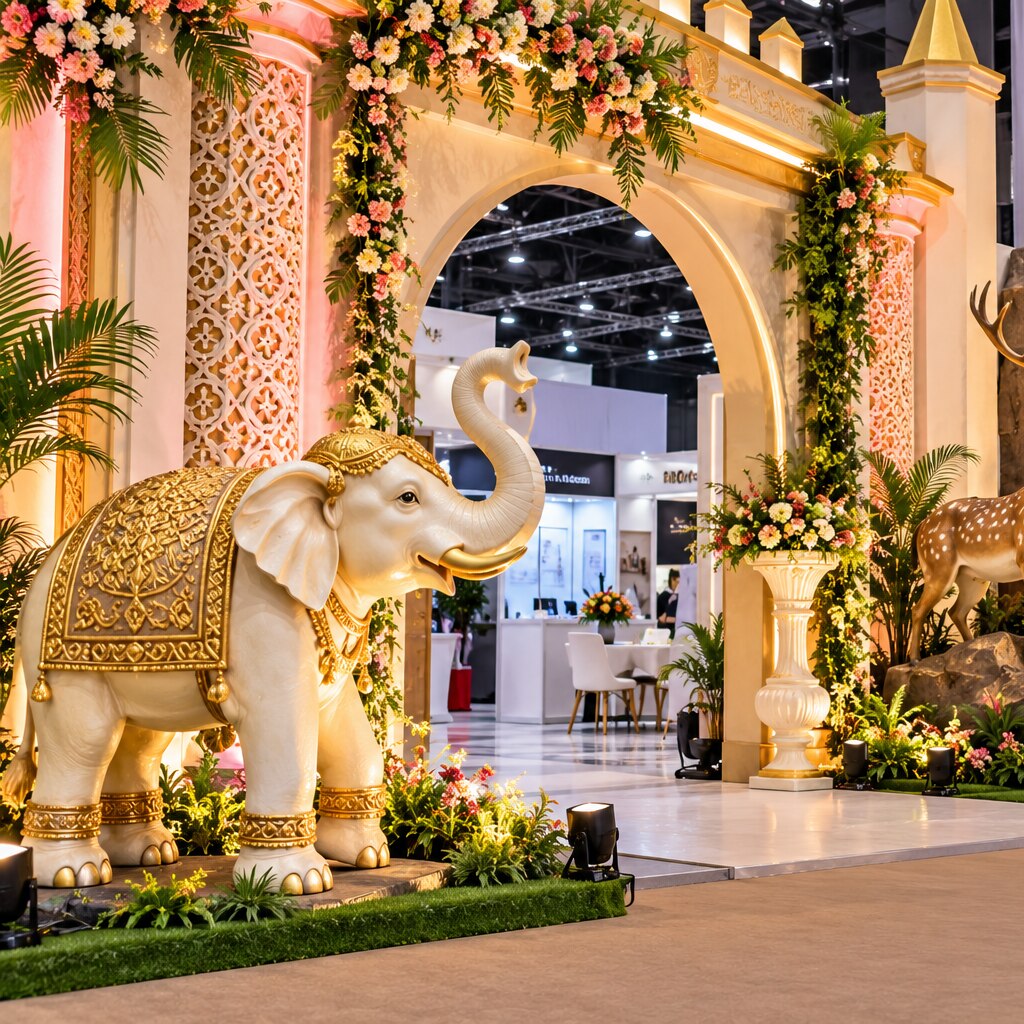
- FRP event decoration creates stage backdrops, arches, and scenic surrounds that establish the event’s visual theme and give photographs a recognisable setting.
- Selfie points and oversized props turn passive visitors into participants, extending the event’s visibility through shared images.
- Themed retail zones use sculpted columns, planters, panels, and ceiling features to guide customers through a story rather than a plain sales floor.
- Branded mascots give a company a physical character for greetings, photo opportunities, product launches, and children’s areas.
- Exhibition entrances use large logos, arches, and three-dimensional letters to signal the brand from a distance and direct visitors into the stand.
- Mall installations act as visual landmarks, helping shoppers find a campaign, seasonal display, or promotional area.
- Restaurant interiors use faux architectural elements, wall reliefs, counters, and themed scenery to create an atmosphere customers remember.
- Showroom displays use shaped product surrounds and façade features to separate product categories and make demonstrations easier to notice.
Permanent outdoor branding needs sealed joints, exterior-grade paint, and UV protection. For large props, an internal frame and anchoring system carry transport, lighting, and wind loads; the visible FRP skin is not automatically structural.
From Concept Sketch to Installation and Dismantling
Begin with concept sketches that show the visitor’s viewpoint, overall height, branding areas and the space available around the object. Convert the approved idea into scale drawings with exact dimensions, split lines, flange locations, lifting points and fixing details.
Check the venue entrance, lift, doorway width and assembly area before fabrication; a finished prop that cannot pass through the access route is an expensive redesign.
1. Build a plug or mould from the approved drawings. The mould determines the shell’s shape, repeatability and visible detail.
2. Follow the FRP moulding process by applying the gelcoat, reinforcement layers and resin to create the hollow shell. Add ribs or a separate timber, steel or aluminium frame where the prop needs stiffness, ballast, lighting, signage or wind resistance.
3. Trim the cured sections, drill fixing points and test-fit every split piece. Large forms commonly arrive in sections because mould release and transport are easier that way.
4. Complete FRP surface finishing by filling pinholes, refining joints, sealing edges and applying compatible exterior paint or UV-stabilised coatings. Outdoor pieces need this protection because sunlight can chalk, fade and dull the surface.
5. Plan transport and assembly around labelled sections, protective packaging, lifting equipment, anchoring and electrical connections. Secure the installation for its actual wind exposure; the FRP skin alone is not automatically load-bearing.
6. Photograph connection points and mark each part before dismantling. Remove fasteners without damaging flanges, pack sections against abrasion, and store them dry with a drawing that records the assembly sequence for the next event.
The Project Details That Control Cost, Safety, and Reuse
A usable FRP project specification must define the venue, operating conditions, construction, and second-use plan before fabrication. An attractive prop can still fail if it cannot pass through the service entrance or withstand outdoor gusts.
- Record overall dimensions, weight, centre of gravity, finish, colour, access-route widths, lift dimensions, door heights, assembly clearances, and the maximum installation time.
- Describe wind exposure: indoor, sheltered outdoor, or fully exposed. State the wind design requirement, ballast weight, fixing points, ground condition, and FRP anchoring method; never rely on the visible shell as its only support.
- Specify the internal frame, ribs, aluminium or steel supports, lifting points, lighting mounts, signage attachments, electrical load, cable routes, and access panels.
- Name the resin and surface coat, such as polyester, vinyl ester, or epoxy, because water resistance, chemical resistance, cost, and curing behaviour differ.
- Document fire safety for FRP across the complete assembly, including resin, paint, foam, fabric, wiring, LED drivers, and frame. Request flame-spread and smoke evidence for the finished construction, not just a raw-material brochure.
- Include cutting and site-modification controls: local exhaust or dust collection, eye protection, gloves, and suitable respiratory protection. Dry grinding in a crowded venue creates avoidable fibre dust.
- Set out dismantling sequence, labelled parts, fasteners, protective wrapping, transport crates, storage limits, inspection points, and the next venue’s dimensions.
For branded work, SHUBH AD'S Pvt Ltd can coordinate panel artwork with final FRP dimensions so graphics, sightlines, and fixing points are resolved before production.
FRP Compared with Thermocol, Wood, Metal, Acrylic, and Printed Panels
Choose FRP when you need a durable, paintable three-dimensional shell that handles moisture, repeated handling and outdoor display better than many lightweight materials. It is less suitable when the campaign is brief, graphics matter more than form, or the venue demands documented low flame spread.
| Option | Strength | Choose it when |
|---|---|---|
| FRP versus thermocol | FRP resists dents and moisture; thermocol is lighter and faster for short use | Select thermocol for a low-cost indoor prop with minimal handling. Select FRP for repeated transport or a lasting sculpted finish. |
| FRP versus plywood and MDF | FRP creates curved, seamless forms; plywood and MDF are easier to cut, screw and modify | Choose plywood or MDF for temporary flat displays, internal structures and quick site changes. The FRP versus plywood and MDF decision favours FRP for shaped, moisture-exposed surfaces. |
| FRP versus metal and acrylic | Metal offers structural strength; acrylic provides clear, glossy or translucent graphics | Choose metal for load-bearing frames and acrylic for illuminated lettering or graphic panels. The FRP versus metal and acrylic choice favours FRP for moulded, opaque forms. |
| Printed panels | They deliver sharp graphics with low weight and rapid replacement | Use them when the message changes often or storage space is limited. |
FRP is not fireproof. Standard polyester resin can add fuel and smoke, so request documentation for the complete assembly, including paint, foam, wiring, drivers and frame; choose certified mineral-faced or low-flame-spread construction for fire-sensitive venues.
Include repair access in the specification. FRP repair and reuse normally means grinding back damage, re-laminating and refinishing, while thermoset offcuts have weak recycling routes. Concealed split lines, flanges and lifting points also make repeated installation practical.
Frequently asked questions
What is FRP decoration used for?
FRP decoration is used for event props, themed interiors, exhibition displays, retail installations, commercial features, and other moulded visual elements.
How does an FRP project progress from design to installation?
The process moves from concept sketches and measurements to mould or pattern development, fabrication, finishing, transport, site installation, inspection, and dismantling.
What project details affect the cost and safety of FRP decoration?
Size, shape complexity, surface finish, internal structure, weight, anchoring, transport, installation time, fire requirements, and reuse plans affect the project.
How does FRP compare with thermocol, wood, metal, acrylic, and printed panels?
FRP offers moulded, rigid forms and a durable surface, while thermocol suits lightweight short-term work, wood supports carpentry, metal provides structural strength, acrylic gives clear or glossy finishes, and printed panels deliver flat graphics.