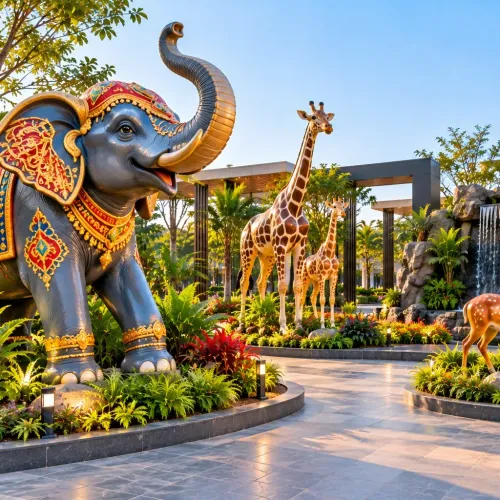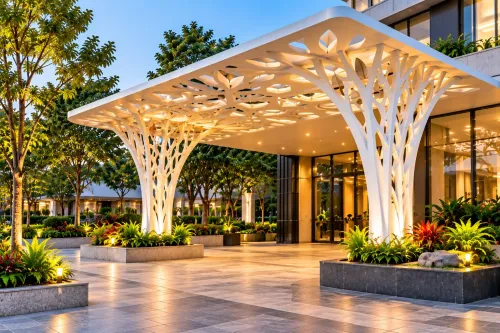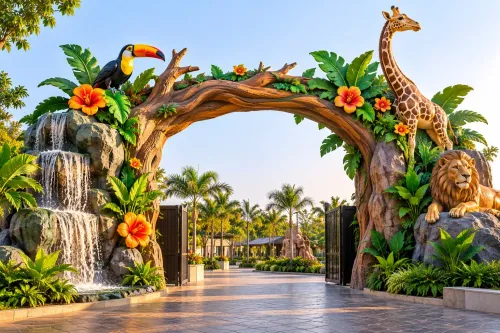
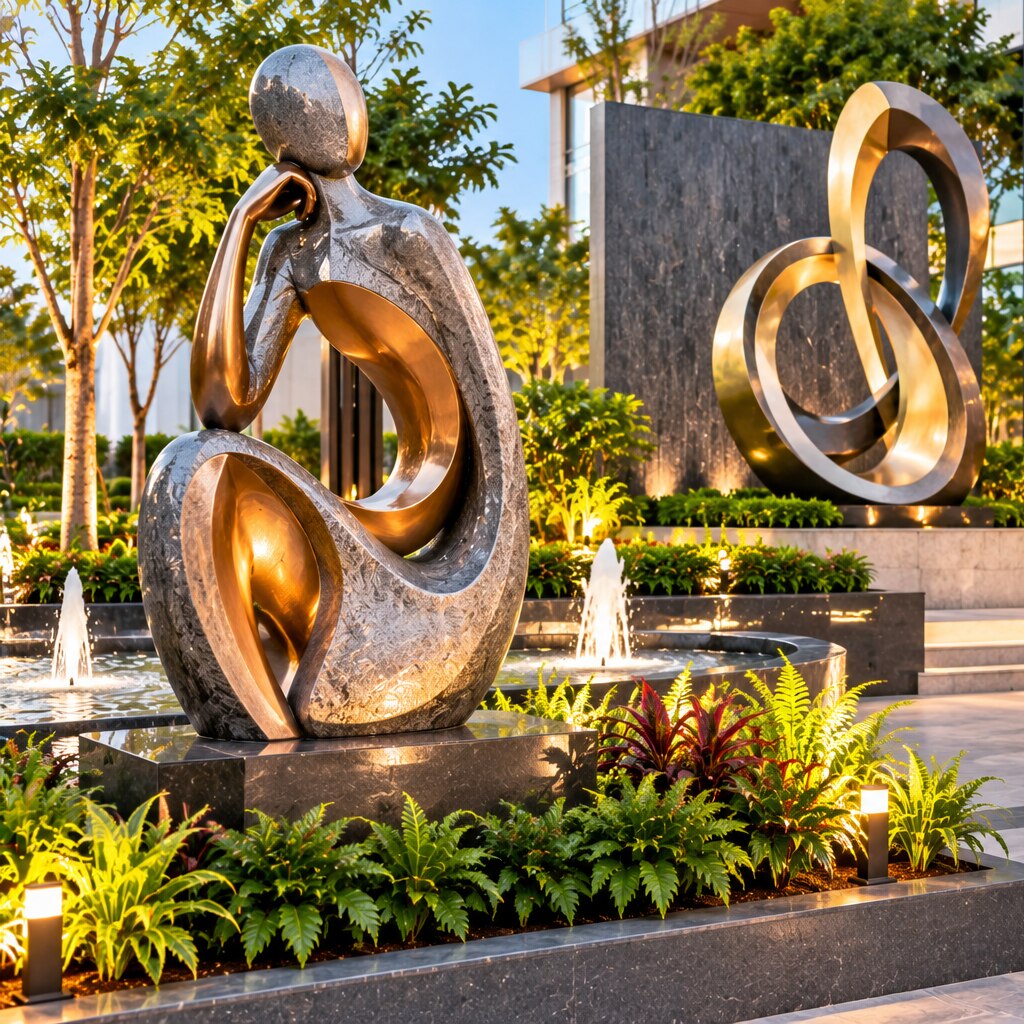
Choosing a sculpture involves more than selecting an attractive shape: the material, scale, mounting method, weather exposure and public access all affect whether the installation succeeds. By the end, you will be able to compare design approaches, test a proposal for safety and durability, and request a quotation that covers the complete installation rather than the object alone.
Key takeaways
- Match material and scale to the space, viewing distance, and exposure.
- Compare FRP build-up, metal thickness, finish, anchoring, and maintenance.
- Specify wind loads, foundation details, drainage, and weather-resistant coatings.
- Check dimensions, surface finish, fixings, and site safety before handover.
Which Sculpture Materials and Forms Suit Your Space?
FRP sculpture and fiberglass sculpture are closely related: FRP means fibre-reinforced polymer, while fiberglass usually describes glass fibre set in resin. Compare the complete build-up, not the label.
| Material | Finish and production | Weight, repairability and repeatability | Suitable use | Reject when |
|---|---|---|---|---|
| FRP/fiberglass | Moulded, smooth, painted; repeats accurately | Light, patchable, highly repeatable | Indoor focal points and sheltered outdoor forms | Fire documentation is absent or impact is severe |
| Metal | Fabricated, welded, powder-coated or painted | Strong, repairable, repeatable; heavy in thick sections | Outdoor entrances, reliefs and structural installations | Rust traps, sharp edges or excessive heat are unmanaged |
| Stone | Hand-finished, natural variation | Very heavy, difficult to repair or relocate | Permanent outdoor focal points and stone sculpture designs | Floors, foundations or access cannot carry it |
| Concrete | Cast or hand-textured; porous unless sealed | Heavy, durable, repeatable from moulds | Plinths and robust outdoor structures | Cracking, water ingress or lifting access is unresolved |
| Wood | Hand-sculpted or CNC-cut; visible grain | Moderate weight, repairable, less uniform | Dry interiors and protected entrances | Moisture, termites or fire classification is uncertain |
| Resin | Cast, polished or pigmented | Light to medium; repairs can show | Indoor decorative details | Sunlight, heat, impact or fire compliance is demanding |
| 3D-printed components | Digitally modelled, layered surface | Lightweight, repeatable, modular | Prototypes, lettering and complex interiors | Outdoor exposure or a flawless close-up finish is required |
Choose a form that matches both use and load:
- Freestanding or entrance installations need a stable base; use modular construction when gates, lifts or turning radii restrict delivery.
- Wall-mounted reliefs save floor space but require verified wall capacity and concealed fixings.
- Suspended pieces need rated suspension points and controlled movement.
- Functional decorative structures need maintenance access, especially around lighting and controls.
Use solid stone or concrete for permanence; use a lightweight shell for height, transport and reduced impact risk. Confirm fire classification for resin, FRP, adhesive, paint and backing together. Avoid porous wood outdoors, unprotected metal in wet locations and any finish that cannot be cleaned or locally repaired.
How Do You Select the Right Sculpture Design for a Site?
Select the sculpture by what the site demands, not by a standalone image. An interior sculpture design viewed from two metres needs readable detail and controlled edges; outdoor sculpture design seen across an entrance plaza needs stronger silhouette, larger lettering and long-distance recognition.
1. Complete a site survey. Record available height, width, depth, floor or foundation condition, pedestrian flow and sightlines from entrances, reception desks, roads and waiting areas. Mark accessible routes, fire exits, maintenance access and likely viewing distances.
2. Match the form to its setting. Compare the colour palette and existing architecture, then test brand colours, symbols and typography against the wall, paving and surrounding landscape. Sunlight, indoor lighting, shadows and reflections can change the apparent colour and legibility.
3. Design for contact and exposure. Wind, strong sunlight, dust, monsoon moisture, seasonal temperature changes, vandalism and public touching affect the shape, finish, fixings and cleanability. Avoid sharp accessible edges, trip points, head-strike zones, protruding hardware and pockets that retain water or dust.
4. Approve a technical package before fabrication: dimensioned drawings, elevations, material notes, finish samples and lighting positions. For branded or three-dimensional lettering, require a full-scale or near-full-scale mock-up.
Computer renders hide seam visibility, edge thickness, glare, LED hotspots and the apparent size of lettering. Review the mock-up from the actual viewing angles and distances, under the intended lighting, before approving production.
What Makes an Outdoor Sculpture Structurally Safe and Weather-Ready?
Treat an outdoor sculpture as a small structure, not an enlarged interior object. Its solid-looking or perforated form can act as a wind sail, so the design package must assess wind loads, overturning, sliding, anchor-bolt tension and the foundation under IS 875 (Part 3).
A structural engineer must sign off the final connection and foundation design.
- Confirm the substrate thickness, reinforcement, embedment depth and anchor edge distance. Check concrete breakout, grout condition and drainage around every anchor; a base plate on paving is not automatically safe.
- Design temporary event sculptures for the full event period, including an unoccupied site. Specify anchorage or ballast for wind uplift and overturning, especially with banners, hollow forms and panels.
- Detail underside and rear surfaces with waterproofing, drainage holes, venting, insect screens where needed, sealed end caps and service access. Closed pockets and horizontal ledges trap monsoon water and dust.
- Specify UV-resistant finishes and corrosion protection by treating welds, cut edges and crevices. Control galvanic corrosion, Corten runoff and repainting; a duplex coating system of hot-dip galvanizing plus compatible paint or powder coating needs verified preparation and compatibility.
- Inspect sharp edges, trip hazards, head-strike zones, protruding fixings and blocked accessible routes. Keep maintenance access clear, and check the site plan for fire egress and crowd movement rather than relying on an elevation drawing alone.
How Should You Compare Fabrication Methods, Costs and Project Timelines?
Compare methods against the same decision points, not an attractive object price. Hand-sculpted versus moulded FRP differs most in surface character and repeatability, while a CNC-cut sculpture or digitally modelled design can shorten production after the geometry is approved.
| Method | Finish quality | Repeatability | Lead time | Repairability and cost drivers |
|---|---|---|---|---|
| Hand-sculpted | Unique tool marks and irregularity | Low | Longer | Skilled labour, pattern changes and hand finishing |
| Moulded FRP | Consistent contours and lightweight shells | High | Moderate after mould-making | Mould cost, gelcoat, internal framing and patch repairs |
| Fabricated metal | Visible welds, seams or polished surfaces | Moderate | Moderate | Metal thickness, welding, corrosion protection and lifting |
| CNC-cut sculpture | Precise profiles and repeatable parts | High | Shorter after files are ready | Programming, sheet waste, assembly and edge finishing |
| 3D-printed components | Complex geometry and layered texture | High for approved files | Size-dependent | Print time, material, support removal and coating |
A complete sculpture quotation must list concept sketches, 3D renderings, material specification, dimensions, finish samples, fabrication, transport, lifting equipment, installation, anchoring, electrical work, taxes and aftercare terms. SHUBH AD'S Pvt Ltd can be assessed against this complete scope rather than an isolated object price.
Large forms usually travel as modules. Show seam locations, lifting points, centre-of-gravity information, temporary bracing, bolt access and the site assembly sequence; confirm gates, lift dimensions and turning radii before fabrication.
Break the project timeline into:
- Concept approval and prototyping
- Fabrication
- Site preparation
- Delivery and installation
Confirm time allowances after design, access-route checks and mock-up approval. A full-scale mock-up exposes seam visibility, edge thickness and lettering size that renders hide.
What Should You Check Before Installation and Handover?
Approve the piece only after it passes a sculpture installation checklist covering access, structure, electrics, finish and future maintenance.
1. Measure the route, not just the display area. Record gate widths, lift dimensions, ceiling height, turning radii and floor capacity. A sculpture that cannot pass the narrowest turn is not buildable.
2. Confirm the module seams, lifting points, centre of gravity, lifting plan, temporary bracing and bolt access. Approve the site assembly sequence before delivery, including anchor access and the order for joining, levelling and securing each section.
3. Review IP ratings for illuminated sculptures under IEC 60529. IP6X means dust-tight, IPX5 means resistance to water jets and IPX7 means temporary immersion under test conditions; IP67 is not automatically rated for high-pressure jets. Check drivers, transformers, connectors, cable glands and access doors separately.
4. Require LED driver access for replacement, with ventilation or other thermal management. Do not permanently seal control gear inside a dark metal cavity, where heat can shorten its service life.
5. Collect maintenance and handover documents containing material and finish specifications, coating batch details, electrical single-line diagrams, anchor and foundation drawings, lifting instructions, approved cleaning products, spare finish samples and inspection intervals.
6. Agree how sun, dust and monsoon exposure will affect fading, chalking, gloss loss, adhesion, repainting and touch-ups. Specify the approved repair coating before installation, or later repairs can visibly mismatch and weaken corrosion protection.
Frequently asked questions
Which sculpture materials suit indoor and outdoor spaces?
Choose FRP for lightweight complex forms, metal for strength and a visible structural character, and stone or concrete for mass and permanence. Match the material to moisture, sunlight, handling, and maintenance requirements.
How do you select a sculpture design for a site?
Assess the site’s scale, viewing distance, pedestrian movement, architecture, lighting, colour palette, and purpose. A design for a lobby requires different proportions and finishes than one for a traffic island or open plaza.
What makes an outdoor sculpture structurally safe?
Specify the sculpture’s weight, centre of gravity, wind exposure, structural frame, anchor bolts, foundation, drainage, and corrosion protection. Obtain structural review when the installation is tall, heavy, publicly accessible, or exposed to strong wind.
How should you compare sculpture fabrication methods and timelines?
Compare the design’s mould or tooling needs, material thickness, internal frame, surface finishing, transport requirements, installation method, and repair access. Request a stage-by-stage schedule covering design approval, fabrication, finishing, delivery, and installation.
What should you check before sculpture installation and handover?
Verify the approved dimensions, colours, finish quality, anchor locations, foundation readiness, lighting clearances, drainage, access routes, and site protection. Record photographs, maintenance instructions, warranty terms, and final acceptance measurements.