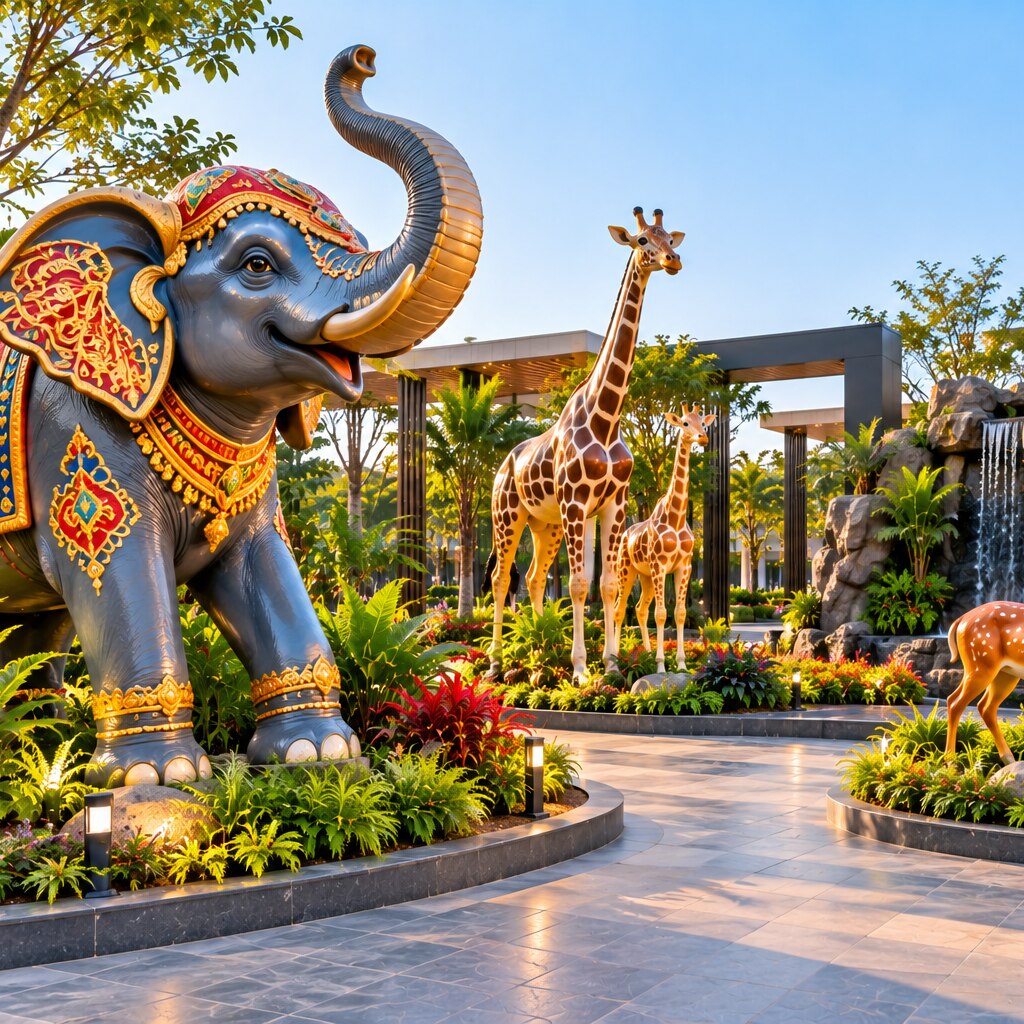
A successful FRP statue starts with site conditions, visitor behaviour, structural loads, and transport constraints—not with a decorative sketch alone. By the end, you will know what information to provide, how fabrication and installation are sequenced, and which technical details to require before comparing quotations.
Key takeaways
- Measure viewing distance, access routes, weather exposure, and foundation space first.
- Request scaled drawings showing the statue, frame, base, anchor points, and installation method.
- Compare quotations for testing, transport, lifting equipment, finish specifications, and handover documents.
- Choose UV-resistant finishes and corrosion-protected supports for exposed outdoor installations.
Turn the Site, Theme, and Viewing Distance Into a Design Brief
A statue cannot be designed from a theme alone. Before sketching, record the site dimensions, intended height and footprint, available foundation, access route, weather exposure, lighting, and the distance from which visitors will see it.
These decisions become the FRP statue design brief and prevent a visually impressive object from blocking paths or arriving too large for the site.
1. Map pedestrian flow, queue areas, vehicles, emergency routes, viewing angles, and visitor contact. A mascot beside a walkway needs different proportions and barriers from a landmark sculpture viewed across a park.
2. Confirm the theme, reference artwork, brand rules, colours, facial details, text, and the level of realism required. State which features must remain visible at the farthest viewing distance.
3. Measure the transport route, including gates, turning radii, door heights, lifts, overhead clearances, and unloading space. Set maximum module dimensions and document concealed joints, flanges, lifting lugs, centre-of-gravity marks, sling angles, temporary bracing, and the assembly sequence before fabrication.
4. Establish the structural design case: foundation capacity, anchor locations, projected area, openings, height, gusts, and site exposure. Outdoor installations in India are normally checked against IS 875 (Part 3) and applicable local foundation requirements; wind can govern even when the FRP shell is lightweight.
5. Specify expected contact, vandalism, drainage, fire criteria, and material build-up. Resin type, glass-fibre schedule, gelcoat, core, reinforcement, and topcoat matter more than a quoted shell thickness; indoor venues must obtain flame-spread, smoke, toxicity, and fire-rating requirements from their approval process.
From Sketch to Finished Shell: The FRP Design and Fabrication Sequence
A custom statue becomes transportable through a controlled sequence: define the form, resolve its structure and joints, create a mould, build the shell, finish the surfaces, then prepare each module for handling.
1. Start with sketches that show front, side, rear, and critical viewing angles. Confirm the overall height, width, pose, proportions, access openings, and module break points before detailed work begins.
2. Build a 3D modelling file from the approved concept. The model exposes thin projections, deep recesses, centre of gravity, transport dimensions, concealed joints, and flange locations before they become fabrication problems.
3. Produce a full-size pattern in clay, foam, or another suitable material, then complete FRP mould-making. Set split lines, parting flanges, draft angles, and access to undercuts carefully; a badly placed seam can land across a face or prevent mould removal.
4. Prepare the mould, apply the specified gelcoat, and build the shell through lamination. Require the resin type, glass-fibre percentage and orientation, laminate schedule, core material, and internal ribs or bulkheads—not only a shell-thickness figure.
5. Cure the modules, trim their edges, close engineered joints, and sand the visible surfaces. Apply primer, colour coats, and a protective topcoat suited to the venue, weather, cleaning method, and expected visitor contact.
6. Add documented lifting points, centre-of-gravity marks, temporary bracing, and module identification. Verify maximum transport dimensions, sling angles, concealed fasteners, and the site assembly sequence before dispatch.
The handover should include the approved drawings, finish specification, lifting instructions, joint details, inspection record, and installation requirements. That paperwork prevents a finished shell from being damaged by an improvised lift or uncertain assembly.
Design the Frame, Base, and Installation for Real Outdoor Loads
A lightweight FRP shell can overturn even when its self-weight seems substantial. Design wind stability from projected area, shape-dependent pressure, site exposure, height, gust speed, and openings, then check the result against IS 875 (Part 3) and local foundation requirements. Do not size the base from dead weight alone.
The internal steel framework or GI framework must follow the sculpture’s centre of gravity and lifting points. Reinforce projecting legs, wrists, tails, horns, and signs because these thin sections attract bending and cracking.
Separate carbon steel from FRP with isolation washers or sleeves, compatible coatings, sealed penetrations, and drainage; a persistently wet conductive interface accelerates corrosion.
Require the installation drawing to show:
- Baseplate thickness, anchor plates, anchor-bolt diameter, embedment, edge distance, welds, grout, and corrosion protection.
- Concrete strength, foundation depth, breakout resistance, sliding, overturning, and uplift checks.
- Lifting points, temporary supports, assembly joints, and the safe sequence for unloading and erection.
- Inspection openings at structural connections and high-risk cavities, so hidden welds, bolts, and corrosion remain accessible.
- High-point ventilation where needed, sealed joints, and low-point drain holes directed away from paths and finished paving.
A hollow statue also needs water control. Trapped water adds weight, causes blistering and biological growth, and corrodes the frame; in cold climates, freezing can split joints. Inspect the base connection after grouting, confirm the statue is plumb, and record bolt tightening, drainage, and final sealant condition at handover.
Choose Materials, Finishes, and Construction Details for the Venue
Choose FRP when you need a large, sculptural form with lower dead weight, detailed contours, faster fabrication, and manageable transport. It suits parks, resorts, events, malls, entrances, and showrooms when the shell receives a properly engineered frame, baseplate, drainage, and anchorage.
FRP versus concrete and fiberglass-reinforced concrete is mainly a weight-and-durability decision: FRP reduces lifting and foundation loads, while mineral-based materials provide greater mass and stronger resistance to casual impact. Metal handles slim structures and repeated impact well but needs corrosion protection. Wood offers warmth but demands regular sealing.
Thermocol is useful for temporary, lightweight displays, not a durable exposed finish.
| Material choice | Strength | Best fit | Main risk |
|---|---|---|---|
| FRP | Light, mouldable shell | Detailed permanent or temporary statues | Impact, UV and fire performance depend on the build-up |
| Concrete | Heavy, rigid mass | Fixed outdoor installations | Transport and foundation loads |
| Fiberglass-reinforced concrete | Rigid, textured skin | Architectural forms needing mineral finish | Cracking and higher weight |
| Metal | High structural capacity | Slim frames and exposed elements | Corrosion and heat |
| Wood | Natural appearance | Covered or character-led settings | Moisture, insects and movement |
| Thermocol | Very light, quick to shape | Short-term indoor displays | Fragility, solvents and fire |
Do not approve “FRP” or a shell thickness alone. Require the resin type, glass-fibre percentage and orientation, laminate schedule, core, internal reinforcement, gelcoat, pigments, and topcoat.
- Specify UV protection, colour and gloss tolerance, repair method, and clear-coat coverage.
- Obtain the venue’s flame-spread, smoke, toxicity, and fire criteria; ASTM E84 is a surface-burning result, not a universal fire-resistance rating.
- Set maximum panel deflection and reinforce legs, wrists, tails, horns, attachment points, and steel interfaces with sealed, drained, isolated connections.
Compare Quotations by Drawings, Testing, Transport, and Handover
A low quote is not comparable until it shows what you will receive. Require the approved 3D model or shop drawings, overall dimensions, viewing elevations, laminate thickness, resin system, glass-fibre schedule, internal frame, joints, base connection, finish, and maximum unsupported-panel deflection.
| Quotation item | Require in writing | Inspect before acceptance |
|---|---|---|
| Drawings and construction | Module sizes, concealed joints, attachment inserts, lifting lugs, centre-of-gravity marks, and installation sequence | Dimensions against the approved model; seams, inserts, access panels, and drainage |
| Materials and finish | Resin system, laminate build-up, gelcoat, pigments, UV-resistant topcoat, and fire treatment | Colour, gloss, pinholes, cracks, print-through, edge sealing, and coating damage |
| Testing and records | Batch records, photographs before hollow sections close, structural calculations, and coupon or witness-panel results where risk justifies them | Test reports naming the actual laminate construction and thickness, not only a resin brand |
| Transport and handover | Maximum module dimensions, sling angles, temporary bracing, packing, site assembly, touch-up materials, drawings, and maintenance instructions | Safe lifting points, marked modules, complete fasteners, spare coating, and signed handover documents |
Treat an ASTM E84 report as a surface-burning result, not proof of fire resistance for the entire three-dimensional statue. Confirm the venue’s flame-spread, smoke, toxicity, and fire-rating criteria, then test the actual fire-treated laminate.
If SHUBH AD'S Pvt Ltd coordinates the statue with surrounding signage, separate FRP fabrication, graphics, lighting, transport, and installation as line items. That exposes omissions before approval.
Reject delivery for unrecorded substitutions, cracked joints, missing lifting information, or dimensions outside the approved drawings. A good-looking shell can still fail during lifting or public use.
Frequently asked questions
What should a design brief for a custom FRP statue include?
Record the site dimensions, statue height and footprint, viewing distance, access route, foundation, lighting, weather exposure, and venue theme.
How is a custom FRP statue made?
The sequence runs from concept sketches and scaled drawings to pattern making, mould preparation, FRP lay-up, curing, trimming, assembly, finishing, and inspection.
How should an FRP statue be designed for outdoor installation?
Specify an internal frame, stable base, anchor points, suitable foundation, lifting provisions, drainage, and protection against wind, rain, sunlight, and corrosion.
What should you compare in custom FRP statue quotations?
Compare drawings, dimensions, materials, finish samples, structural details, testing, transport, lifting, installation, repairs, and handover documents.