A memorable entrance must do more than frame a doorway: it has to communicate the venue theme, survive weather and crowd contact, and keep people, vehicles, and emergency routes moving safely. By the end, you will be able to match an FRP gate concept to your site, compare practical configurations, brief a fabricator, and identify situations where another entrance system is the better choice.
Key takeaways
- Define the visitor reaction before selecting a gate shape.
- Measure road width, queue space, clearance, and installation access.
- Specify wind loads, anchoring, weatherproofing, graphics, and maintenance.
- Compare FRP with steel, wood, concrete, and foam before approving quotes.
Choose the Gate Story Before You Choose the Shape
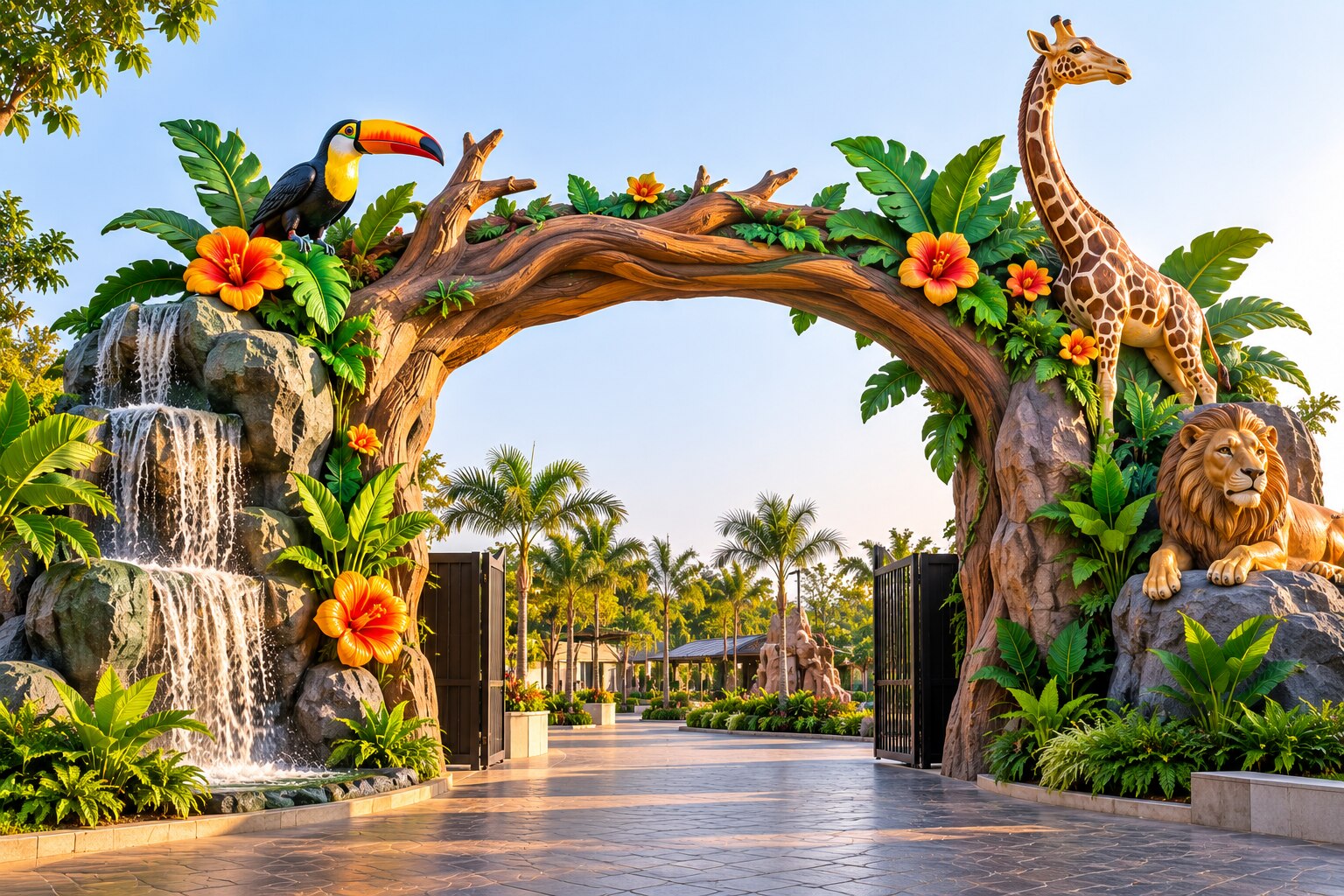
Start with the visitor’s expected reaction, not the material or silhouette. A theme park entrance gate should promise adventure to children and read clearly in a crowd; a resort entrance design should signal place, comfort, or local character; an event gateway should communicate the event theme within seconds.
| Concept | Best venue and audience | Viewing distance and behaviour |
|---|---|---|
| Jungle portal gate concept | Wildlife parks, adventure attractions, eco-resorts, family audiences | Strong at approach distance; visitors stop for photographs and touch textured details |
| Castle or fantasy gateway | Theme parks, children’s attractions, ticketed experiences | Tall towers read from parking areas; families gather beneath the arch |
| Regional-culture gateway | Resorts, civic spaces, festivals, public plazas | Recognisable motifs reward closer viewing; visitors pause for group photographs |
| Nature-inspired arch | Wellness resorts, gardens, exhibitions, environmental events | Open forms preserve sightlines; visitors pass continuously with fewer contact points |
Use oversized shapes only when people will see the gate from far away. At close range, layered relief, carved texture, lettering, and lighting carry more interest than a wide blank arch. A small event entrance benefits from a removable portal or branded photo wall rather than a monumental structure.
Design for behaviour as deliberately as appearance. If visitors will lean, climb, queue, or take selfies, keep fragile projections and sharp FRP edges away from hand height. Leave the accessible route and emergency flow independent of the scenic story; a beautiful gate that narrows movement becomes a queue problem.
These creative FRP entrance gate ideas succeed when the narrative, audience, distance, and movement pattern agree.
Match the Concept to a Gate Configuration and Site Dimensions
Set the clear route before drawing the scenic shape: keep at least 1.5 m of unobstructed pedestrian width for an accessible path, with no raised threshold, guy wire, sharp corner, or low projection. Add queue lanes around the feature, not through it; allow roughly 1.2–1.5 m per lane and preserve a separate emergency egress route.
Choose the configuration that matches the available footprint:
- A single arch entrance suits a compact site. Give it a 2.4–3 m clear pedestrian opening, then widen the foreground if groups will stop for photographs.
- A twin-tower gateway keeps towers outside the queue and frames a 3–5 m opening. Use it where visitors need a strong sightline from a road or plaza.
- A layered portal adds depth without requiring a long passage. Keep each overhead layer outside the clear route and limit the projection where queues turn.
- A tunnel entrance gate needs more room: provide at least 2.4 m clear width, continuous lighting, and an unobstructed exit. Do not let scenery create a blind corner.
- For vehicles, start with a 3.5 m one-way or 6 m two-way opening, plus clearance above the tallest vehicle. Keep towers outside the turning path.
Reserve 4–6 m in front of the gateway for group photography when the site allows it. Check workshop doors, transport vehicles, venue gates, stairwells, and lifting equipment before fixing dimensions; divide large FRP forms into modules with concealed bolted joints and alignment keys rather than creating an immovable seamless arch.
Understand How a Large FRP Gate Is Fabricated and Assembled
A large sculpted gateway should be treated as a visual FRP shell, not a load-bearing structure, unless an engineer designs it as a structural composite. Tall arches, oversized logos, and solid sign faces need an internal steel frame, engineered base plates, and concealed inserts so bolts do not pull through the laminate.
FRP mould fabrication controls the surface quality and repeatability; the quoted laminate thickness, stiffening ribs, frame connections, and access panels control durability. Divide the design into a modular FRP gate with concealed bolted joints and alignment keys when workshop doors, vehicle loading, venue gates, lifting equipment, or storage space cannot accommodate one-piece construction.
A complete quotation must separate:
- Pattern or mould fabrication
- FRP shell and laminate thickness
- Internal steel frame and base plates
- Surface finish, raised letters, and graphics
- Lighting fixtures, wiring harnesses, conduits, and access
- Engineering, anchoring, ballast, and site verification
- Transport, lifting, installation, dismantling, and storage
Keep illumination serviceable rather than permanently burying it inside the shell. Use replaceable sponsor panels and logo plates for repeat events; moulded raised lettering suits the permanent identity, while printed panels carry changing information on curved or textured surfaces.
Specify anchoring independently from fabrication. Ballast blocks, chemical anchors, ground anchors, and bolted base frames impose different pavement, underground-service, removal, and surface-restoration requirements. Confirm the installer’s method before production, or a finished gate can arrive without a safe way to secure it.
Specify Safety, Weather, Graphics, and Maintenance Before Production
1. Request a signed FRP gate wind loading note covering overturning, sliding, uplift, and local pressure on letters or sculpted projections. It should cite IS 875 Part 3 and show the design wind speed, foundation assumptions, safety factors, and connection details. A heavy-looking gate can still move on pavers, asphalt, or temporary flooring.
2. Specify FRP gate anchoring separately from the scenic shell. Require the installer to confirm whether the site permits ballast blocks, chemical anchors, ground anchors, or a bolted base frame, then verify underground services, pavement thickness, access for equipment, removal time, and surface reinstatement.
Keep the clear pedestrian route independent of the arch, with no raised threshold, guy-wire hazard, sharp edge, or low projection.
3. For an indoor hall, enclosed venue, or installation near an exit, reject “fireproof FRP” as a specification. Request the actual laminate fire-test classification, smoke information, resin and gelcoat details, and electrical documentation; fire-retardant FRP does not make the whole gate non-combustible. Obtain venue or fire-authority approval where required.
4. Approve a finish and service schedule before mould-making. Ask for UV and moisture protection, colour references, graphic application and replacement method, edge protection at hand height, cleaning products, inspection intervals, and repair materials.
For LEDs, require drainage, weather-appropriate enclosures and connectors, protected cable routes, replaceable modules, accessible drivers, and documented electrical protection; an IP rating under IEC 60529 covers enclosure protection, not the entire installation.
5. Make the quotation identify laminate thickness, internal frame, graphics, lighting, engineering, transport, ballast or anchoring, installation, dismantling, storage, and mould work separately. Surface area alone hides the cost of a safe entrance.
Compare FRP With Other Entrance-Building Options Before You Approve the Quote
Choose FRP when the entrance needs sculpted, weather-resistant forms that visitors will photograph and reuse across campaigns. It is the right investment for a permanent resort portal or repeat event, not automatically for a one-day photo point.
| Option | Strength | Best use | Main drawback |
|---|---|---|---|
| FRP versus ferrocement | Lighter, detailed, repairable skin | Sculpted portals and repeat transport | Needs an internal frame and careful handling |
| Steel frame cladding | Strong primary frame with replaceable skin | Tall arches, solid sign faces, heavy lighting | More engineering, fabrication and corrosion control |
| Wood | Warm, authentic appearance | Heritage, rustic or short-term themes | Moisture, termites, fire treatment and upkeep |
| Panels | Fast, modular branding | Straight-sided entrances and changing graphics | Limited curves and sculpted depth |
| Inflatables | Fastest deployment and compact storage | Temporary event entrance | Puncture, blower power and wind dependence |
| Backdrops | Lowest-complexity photo branding | Indoor photo walls and short campaigns | Not a three-dimensional gateway |
Your FRP gate quotation should separate:
- Mould or pattern-making, laminate thickness, internal galvanized-steel or aluminium frame, base plates and concealed inserts
- Finish, raised letters, printed panels, lighting, electrical work and engineering drawings
- Transport, ballast or anchoring, installation, dismantling and storage
- Spare panels, repair kit, colour-matched topcoat and documented laminate-repair method
Ask SHUBH AD'S Pvt Ltd to show graphics, exhibition panels and lighting as separate line items if you are comparing suppliers. Verify pavement, underground services and restoration costs before approving anchoring for a temporary event entrance.
Frequently asked questions
How do you choose a creative FRP entrance gate concept?
Start with the reaction and message you want visitors to receive. Use adventure cues for theme parks, local character or comfort for resorts, and a clear event theme for temporary gateways.
What site measurements matter before designing an FRP entrance gate?
Record road width, pedestrian clearance, vehicle height, queue space, setback from traffic, foundation locations, and the route needed to deliver and assemble the gate.
How is a large FRP entrance gate fabricated and assembled?
Fabricators create a shaped mould or structural framework, laminate FRP layers, add internal reinforcement, finish the surface, and transport sections for on-site assembly and anchoring.
What should an FRP gate quote specify?
Ask for structural support, anchoring, wind-load design, weather protection, paint or graphics, lighting, installation, access equipment, cleaning requirements, repair terms, and exclusions.
How does FRP compare with other entrance-building materials?
FRP supports detailed shapes with lower weight than concrete and resists outdoor exposure when finished correctly. Compare it with steel, wood, concrete, and foam for strength, realism, longevity, repair, and installation effort.